Reading Color Without Touching It
- Jul 31
- 6 min read
Updated: Aug 12
UP Diliman School of Archaeology visit to discover the origins of color via portable X-ray fluorescence hidden in our textiles.
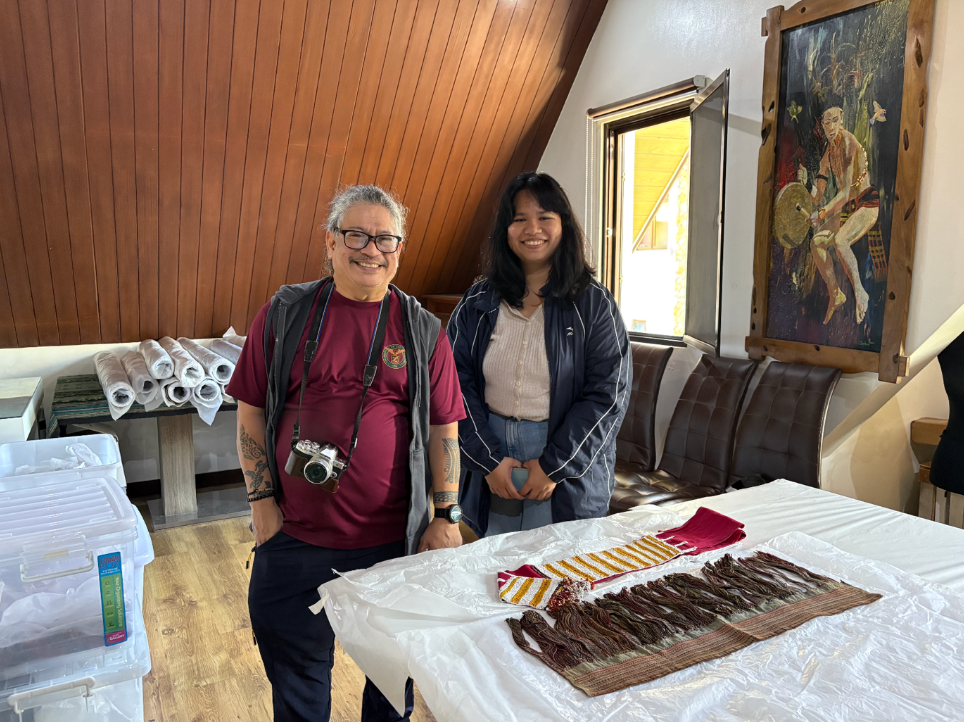
BAHAY UGNAYAN RESEARCH CENTER · BAGUIO CITY · VISIT HELD AUGUST 2025
Some things last, a tooth, a foot bone, a flake of worked stone can wait fifty thousand years in the dark of a cave and still have something to say. Cloth is not like that. In the wet heat of the tropics, textiles rot, fibers collapse and colors fade. The everyday fabric of ancient life, the cordage, the baskets, the dyed and woven things people actually wore, has almost entirely vanished from the Philippine archaeological record.
So, when the team from the UP Diliman School of Archaeology arrived at the Bahay Ugnayan in August, they were chasing something that barely survives at all.
The team that came up the mountain
The visit in August, brought a name well known far beyond Philippine archaeology. Dr Armand Salvador Mijares, UP Scientist and Professor at the School of Archaeology in UP Diliman who led the international team whose work at Callao Cave in Peñablanca, Cagayan, announced to the world in 2019 an entirely new species of human: Homo luzonensis, known from fossils and teeth of at least three individuals, dated to somewhere between fifty and sixty-seven thousand years ago. It is a discovery that put the Philippines on the map of human evolution, and it happened in part because he kept digging where convention said to stop. Alongside that work he has studied the stone-tool traditions of Central Luzon.
With him came Senior Lecturer Patricia Panganiban, a chemist now writing her archaeology dissertation on the natural dyes found on ethnographic textiles from archaeological sites in Northern Luzon.
A chemist reading cloth in an archaeology department is exactly the sort of hybrid work we get excited about!
Why dye is such a hard thing to find
To understand what the archaeologists were after, it helps to understand what they are usually deprived of. Stone endures. Bone, in the right cave, endures. Organic material, plant fiber, thread, cloth, and the plant color worked into it, does not. Across tropical Southeast Asia the textiles of the deep past have overwhelmingly rotted away, which means the archaeological record dramatically under-represents something that was, for the people who lived it, everywhere.
Survivals do exist, and they are treasured precisely because they are so rare. The burial cloth recovered from a cave on Banton, in Romblon, dated to around the thirteenth or fourteenth century, is often described as the oldest surviving textile in the country and possibly the oldest warp ikat in Southeast Asia. Closer to Bahay, the high limestone burial caves of Kabayan in Benguet, cool, dry and stable at altitude, preserved the Ibaloy fire mummies and their wrappings across centuries. These are the exceptions that prove how much has been lost.
Traditionally, identifying the chemistry in a textile meant removing a sample and destroying it, burning it down to its elements to see what it was made of. Which leaves an archaeologist studying color with a hard constraint. The few fragments that survive are far too precious to cut up. For a fragment of thirteenth-century cloth, that is not a trade anyone wants to make.
"The archaeological record has almost no cloth in it. Not because people had none, but because cloth does not wait."
A machine that reads color without touching it
This is where the project’s method comes in. The research uses portable X-ray fluorescence - pXRF - a handheld analyzer roughly the size of a hairdryer. The principle is elegant. Point it at an object and it sends X-rays into the surface; the atoms there respond by emitting X-rays of their own, at energies characteristic of each element. Read those energies and you read the elements present. Nothing is cut away, nothing is consumed, and nothing needs to leave the room, the instrument travels to the object rather than the object to a laboratory, which matters enormously for heritage material too fragile, too valuable or too legally bound to travel.

There is a subtlety worth knowing. What pXRF reads is the inorganic, metals and minerals, rather than the organic dye molecule itself. On a textile that means it picks up mineral pigments, metallic decoration, and above all the mordants: the metal salts that bond color to fiber.
Readers of our Agtina Tayo! story will recognize those immediately. Alum (tawas), iron and copper were the three mordants our natural dyers worked with over the vats in Benguet this April, the same chemistry that decides whether a plant gives up a bright yellow, a sad grey or an olive green. And here is the quiet beauty of the method: the plant dye may fade over centuries, but the metal that fixed it stays put, patient and still legible, an elemental fingerprint of a color long gone.

What a color knows
Why should any of this matter to an archaeologist? Because dyeing is technology, and technology is evidence.
As the project frames it, the way a society dyes its cloth reveals the level of its technical knowledge and the resources within its reach, which plants grew nearby, which minerals could be got, what was traded in and from how far away. The colors chosen carry a meaning beyond the practical: what a community elects to wear, and on which occasions, can encode status, belief and identity.
The Mercedes Zobel collection makes that case eloquently. As the Ga’dang cultural bearers explained on their visit to the Bahay, the triangular antalasik beadwork takes its shape from the thorns of the talasik tree and is worn as a form of protection; the inammata is not merely a diamond but the elaborate, culturally weighted motif that a plain stripe is not. Color and pattern in Philippine textiles are never only decoration. Read the chemistry and you are reading a choice.

Where the Bahay collection comes in
You cannot identify an unknown without a library of knowns. A dye signature pulled from a scrap of excavated cloth means very little on its own, it becomes evidence only when it can be matched against securely identified reference material. So, the preliminary phase of the work is not archaeological at all: it is the patient study of ethnographic and historic textiles, whose plants, methods and provenance can still be established, in order to build a database of known Philippine dyes.
The Mercedes Zobel Collection of Indigenous Philippine Textiles & Objects was identified as an invaluable resource for exactly this. The visiting team found it a good sampling of the range of textiles across Northern Luzon, which is to say, precisely the comparative library the work requires. The collection stops being a set of beautiful objects and becomes a reference instrument.
The ambitions beyond that are twofold: to develop better conservation protocols for the organic materials embedded in textiles, and to deepen the understanding of indigenous Philippine cloth itself.
What happens next
The visit was a scoping exercise, and it did what scoping visits should. The team left impressed and ready to return to access the collection for a period of focused study with lodging at the Research Center - a working residency of the kind the Bahay was built to host.
The partnership will blossom via collaboration with CORDITEX. The Cordillera Textiles Project, convened in 2014 under the University of the Philippines and is led by Dr Salvador-Amores. It has spent a decade bringing anthropologists, botanists, historians, mathematicians and materials scientists to bear on Northern Luzon weaving, recovering patterns that living weavers could no longer produce, and taking the sciences seriously as a way of understanding a craft.
With thanks
The Bahay Ugnayan Research Center thanks Dr Armand Salvador Mijares and Ms Patricia Panganiban of the UP Diliman School of Archaeology for their visit and for the care they have shown the collection, and Dr Analyn Salvador-Amores of UP Baguio and CORDITEX, who pointed them our way.

Comments